
Workstation Vision OEE
The problem
Overall Equipment Effectiveness has been measured for decades, but the inputs are usually counters, PLC signals, and operator entries. Computer vision can do more: it can see what the work is, not just whether the cycle happened. The catch is that vision-based OEE on raw factory floors is messy — lighting, occlusion, motion, multiple cameras per workstation.
The system
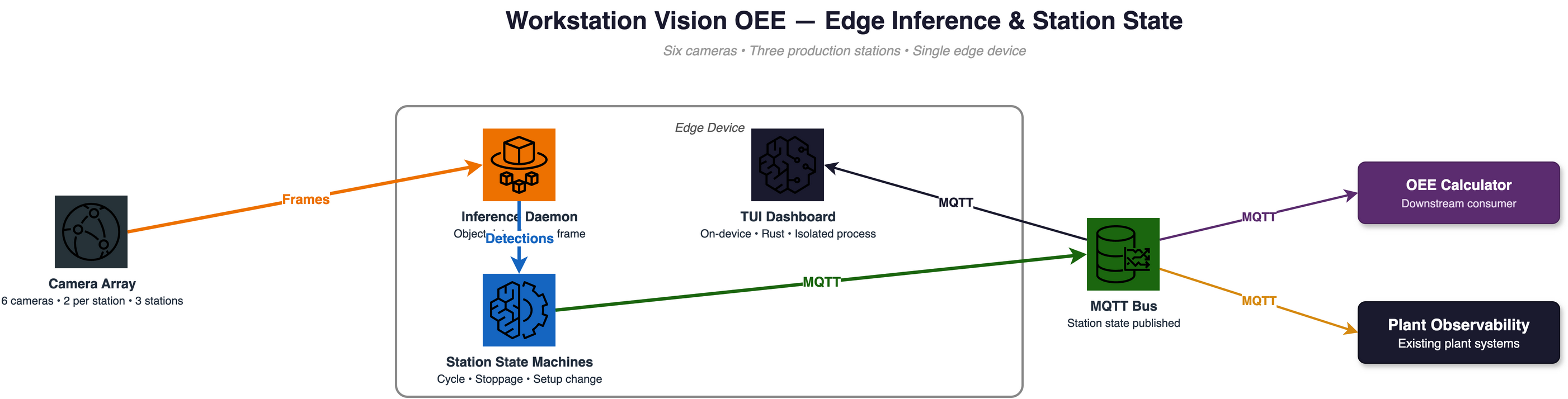
A single edge device sits next to the production line. It pulls frames from six cameras (two per workstation across three stations), runs object detection on each frame, and feeds the detections into per-station state machines. The state machines decide what’s a cycle, what’s a stoppage, and what’s a setup change. The result is published over MQTT as station state, picked up by the plant’s existing observability and any downstream OEE calculator.
Two processes run on the device, sharing nothing but the MQTT bus: a Python inference daemon and a Rust TUI dashboard. If one crashes, the other keeps running.
Architecture
What’s behind the NDA
The full case study (the client, the specific product line, the actual footage, the per-station configuration, and the measured impact) is available under NDA.